
Typology for Dummies (Including Me), Part 2
Updated: Sep 4
Witness Protection ran out. Feds, am I right? Biblical typology is looking at the Old Testament and seeing how early people and events point to something even bigger and better that’s yet to come. Think of it as a blueprint or shadow that leads us to Christ and His amazing work of salvation. The Old Testament figures, events, or institutions (the type) are like the blueprint, but they’re not exactly the same as the fulfillment (the antitype) that we find in the New Testament.
Typology can get a little complicated, so here are a few examples to warm you up on the concept. Just remember that the former (the type) is a lesser example predicting a much better fulfillment in the words and deeds of Jesus Christ (the antitype).

1. Adam is a Typology of Christ as Mankind's Representative
(Romans 5:12-21; 1 Corinthians 15:21-22, 45-49)
As “Man 1.0,” Adam represents the entire human race. To be fair, competition for that election was pretty scant. But his single act of disobedience in the garden led to the introduction of sin and death in the world, which then affected all his descendants. That's you, me, and everybody throughout history. Yikes. But what makes this a typology? The Apostle Paul says that Adam was “a type of the one who was to come” (Romans 5:14), and Christ is often called the “last Adam” or “second man.” Because of Jesus’s obedience on the cross, righteousness and life are now available to everyone who connects with Him. This comparison emphasizes the idea of representative headship, while the difference illustrates the outcome. Huh? Adam’s failure led to condemnation, but Christ’s success brings justification. Adam points forward to the need for a better representative who would undo the damage of the Fall. Jesus is that better/perfect representative for humanity.

2. Noah's Ark is a Typology for Salvation in Christ/Baptism (Genesis 6-9; Peter 3:18-22)
When God retconned the world via a global flood, He provided one means of escape: the ark that Noah built in obedience. Anyone who entered the ark was saved from judgment; any haters outside perished.
Peter draws a direct typological link between the ark in the flood waters and baptism, saying that it points to salvation through the resurrection of Jesus Christ.
Huh? Get to the choppa, Arnold! Just as the ark was the only place of safety during the flood, Christ is the only refuge from the coming judgment of God. Being “in the ark” corresponds to being “in Christ.”
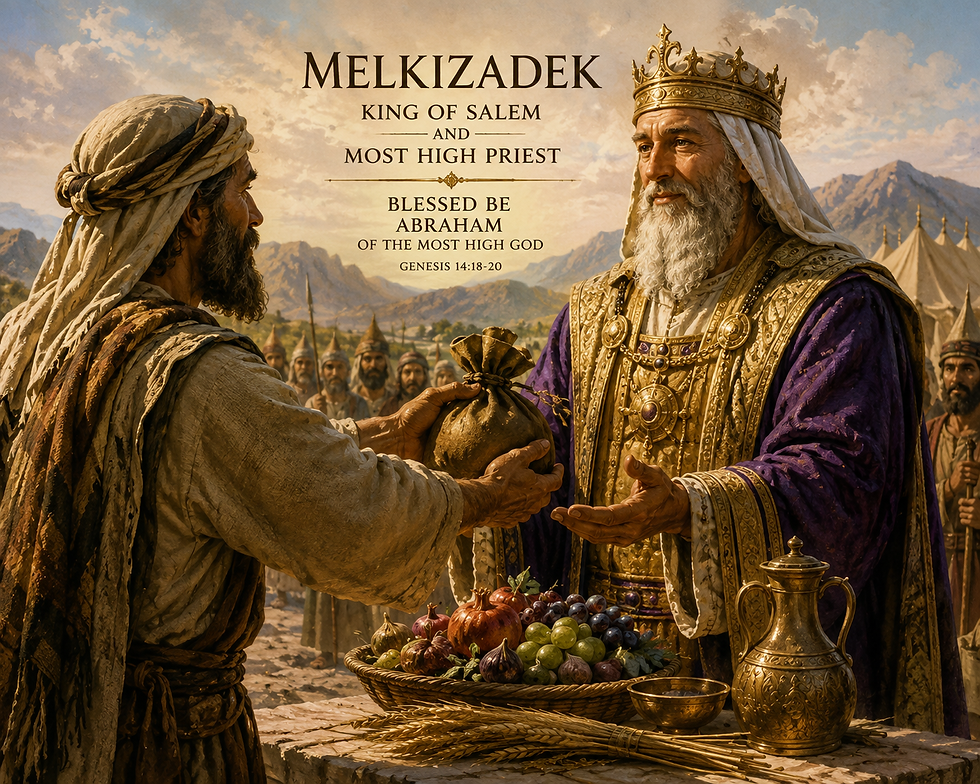
3. Melchizedek is a Typology for Christ's Eternal Priesthood
(Genesis 14:18)
Melchizedek appears suddenly as king of Salem (peace) and priest of God Most High. He blesses Abraham and event receives a tithe from him, yet Scripture gives no record of Melchizedek's parentage, birth, or death.
But the writer of Hebrews uses this silence to present Melchizedek as a type for Christ’s later, superior, and eternal priesthood. Huh? Melchizedek’s dual office (king and priest) hints at Christ’s combined roles as King and High priest for all mankind. Jesus is a priest “after the order of Melchizedek" because he was an unknown Judean from Nazareth, not some nepo baby from the official Levitical line of priests. No, Jesus was from a better, royal priesthood that never ends.

4. Isaac (and the Ram) is a Typology for Christ's Sacrifice (Genesis 22, Hebrews 11:17-19)
Let’s not forget the story of Abraham and Isaac. God asked Abraham to offer his beloved son, Isaac, as a burnt offering on Mount Moriah. Isaac, full of faith, willingly carried the wood to his own sacrifice as he climbed the mountain he was to die on. But just as Abraham was about to make the offering, God sent a ram caught in a thicket to take Isaac’s place as the sacrifice.
Now, in the Passion, God offered his only son, Jesus, as a willing sacrifice for all of humanity’s sins. Jesus carried a wooden cross up a mountain to his crucifixion and death. Hebrews adds another amazing connection: Abraham received Isaac back from the "figurative"dead, which foreshadows the resurrection that was fulfilled when God’s only Son, Jesus, rose from the literal dead.
Huh? Nah, you get this one...

5 Joseph Saving Egypt is a Typology of Christ the Savior NOTE: This one is disputed. Some scholars see a direct link to Christ, but others say it's not strong enough.
Joseph’s life was a rollercoaster: he was adored by his father, but his brothers turned on him, sold him as a slave, falsely accused him, and imprisoned him. But then, he rose to power in Egypt, and was used by God to save many lives (even those who had once rejected him).
The similarities to Jesus are striking: Jesus was the beloved Son of God, he was rejected by His own people, including his brothers (John 1:11). Jesus was sold/betrayed for silver, suffered at the hands of authorities, and became the salvation for both Jews and Gentiles. Joseph’s words to his brothers—“You meant evil against me, but God meant it for good”—resonate with Jesus’ greater purpose on the cross. The Romans and Jews meant evil against Jesus, but God uses him for good to save all who believe.
Huh? You'll be fine from here on out.

6. Passover Lamb is a Typology of Christ
(Exodus 12; 1 Corinthians 5:7; John 1:29, 1 Peter 1:18-19)
On the night Israel was freed from Egypt, every Hebrew family picked a perfect male lamb, killed without breaking a bone, ate its flesh, and put its blood on the doorposts. If the lambs' blood was on the lintel, the Angel of Death would "pass over' their home and not kill their firstborn. Then, everyone would eat the lamb.
Paul makes it super clear: “Christ, our Passover lamb, has been sacrificed.” Jesus is that perfect Lamb of God whose blood makes judgment skip over those covered in it. The lamb represents substitution, the need for blood, and escaping slavery (to sin). We remember when we take Communion, memorializing his sacrifice by eating his body (bread) and drinking His blood (wine). Jesus even died during Passover, which really highlights how connected everything is.
John 19:36 even says that not one of Jesus's bones were broken, just like the sacrificial Passover Lamb. Seriously, I probably should have led with this one. Sorry, not sorry.

7. Manna is a Typology for Christ as the Bread of Eternal Life
(Exodus 16; John 6:31-58; 1 Corinthians 10:3)
When the Hebrews wandered in the wilderness, God gave them daily bread from heaven to keep them alive. It was a wonderful, miraculous gift, but it didn't keep. It fell from Heaven daily, and they learned to rely on God's provision.
In John 6:51, Jesus clearly says He’s the the better manna: “I am the living bread that came down from heaven. If anyone eats of this bread, he will live forever.” The wilderness manna kept the Hebrews alive for a while, but Christ offers to keep up alive eternally. This typology reminds us how God provides, how we need to keep accepting it. Daily.

8. The Bronze Serpent is a Typology of Christ Being Lifted Up on the Cross
(Numbers 21:4-9; John 3:14-15)
After the Hebrews' constant complaining in the wilderness (and our whining and complaining about having to read about it), God sent fiery serpents into their camp. The snakes bit many people, who died instantly. God then told Moses to make a bronze serpent and put it on a pole. Anyone who looked upon the raised serpent would live.
Jesus uses this story as a direct example: “Just like Moses lifted up the serpent in the wilderness, so must the Son of Man be lifted up [on the cross] so that anyone who believes in him may have eternal life.” The serpent (a symbol of the curse) points to Christ, so that those who look to Him in faith are healed from the deadly poison of sin.
Trivia Night Note: This is why you see the Rod of Asclepius—a serpent wrapped around a pole—on many ambulances. If you see that logo coming to your latest bad decision, it means your chances of survival spiked.

9 Jonah is a Typology of Christ's Death and Resurrection
(Jonah 1-2; Matthew 12:38-41)
Not wanting to prophesy/save pagan Ninevites, Jonah took a ship to the farthest corner of the known world. But the Lord sent a storm, and the sailors threw Jonah in the sea to calm the waves. It worked. But Jonah spent three days and three nights in the belly of a great fish, before being vomited onto dry land. He then travelled to Nineveh and delivered the most passive aggressive prophecy possible. Shockingly, the Ninevites took those five words to heart and fully repented; they were spared God's judgement.
Jesus calls this “the sign of Jonah.” the type focuses especially on the death-and-resurrection pattern and subsequent preaching of repentance to Gentiles. Just as Jonah was in the whale for three days before being restored, the Son of Man would be in the heart of the earth three days and nights before also rising and sending the Gospel to Gentiles everywhere.
Final Thoughts This light walk through Biblical Typology shoe how inspiring and fascinating Systematic Theology can be. But typology not a parlor trick. These examples come from decades if not centuries of serious Biblical scholarship. Typologies should be undertaken with reverence and serious consideration. Without this frame of mind and due diligence, you can see typologies everywhere, and some might not hold up (see #5 above). Get lazy and you can end up in late-Beatles Paul is dead territory. For example:

Next Time: No idea but I'll update this page so it looks like I had a plan.

During Covid, the author rediscovered cityonahilldfw.com. Post-vaccination he snuck into a service and felt zero social pressure. He's a member now and everyone knows he sucks at small talk. They don't care: it ain't that kind of church.

Comments